













How to Improve the Contract Management Process
Do you find managing contracts time-consuming, puzzling, burdensome, and distracting? Solve these multifaceted problems using automation and effective contract management systems.

Table of Contents
- What is the contract management process?
- Why having an efficient contract management process is important
- The stages of the contract management process
- Renewal and termination management
- How to improve your contract management process
- How contract lifecycle management (CLM) software can help
- Transform your contracting with the right tools
- Frequently asked questions about the contract management process
Want more content like this? Sign up for our monthly newsletter.
Key takeaways:
- Implement a centralized contract lifecycle management platform to eliminate the fragmentation caused by contracts scattered across email, shared drives, and departments, which prevents teams from accessing critical information quickly and costs companies an average of nine percent of annual revenue.
- Standardize contract creation using pre-approved templates to reduce drafting time from weeks to days while ensuring compliance and allowing teams to focus on customizing business terms rather than rebuilding standard clauses from scratch.
- Automate approval workflows and renewal alerts to route contracts to the right stakeholders based on predefined rules and prevent costly missed deadlines or unwanted auto-renewals that leave value on the table.
- Track contract process metrics like cycle times, bottlenecks, and clause usage to identify inefficiencies, prove the legal team’s value to stakeholders, and make data-driven improvements to your contracting process.
Contract management failures create crisis moments that derail business deals and stress teams unnecessarily.
Picture this scenario: It’s 5 a.m. on a Tuesday, and your sales manager calls with urgent news. Negotiations have wrapped with a promising international client who needs to sign a multi-million dollar agreement within three days.
The contract references documents you haven’t reviewed. Key team members are out of the office. Your sales manager needs immediate approval but can’t provide more time.
Sound familiar? This kind of last-minute fire drill is a symptom of a broken contract management process. When contracts are scattered across email threads, shared drives, and different departments, it’s nearly impossible to move quickly when it matters most. The good news is that it doesn’t have to be this way. With a well-defined process—ideally powered by contract lifecycle management (CLM) software—you can turn contracting from a bottleneck into a competitive advantage.
What is the contract management process?
Let’s cut to the chase. The contract management process is the system you use to handle an agreement from the moment someone asks for it until it’s signed, stored, and eventually expires or gets renewed. Think of it as the entire journey a contract takes through your company.
In the real world, this process is often a mess of emails, shared drive folders, and spreadsheets. A good process, usually powered by a CLM, turns that chaos into a predictable workflow. It’s not about adding bureaucracy; it’s about making sure nothing falls through the cracks, deals move faster, and your team isn’t stuck chasing signatures or searching for the final version of a document.
The goal is simple: get contracts created, approved, signed, and stored in a way that’s fast, compliant, and doesn’t require heroic effort from your team. When it works well, contract management fades into the background. When it doesn’t, you end up with 5 a.m. phone calls.
Why having an efficient contract management process is important
Here’s the reality: poor contract management costs companies nine percent of annual revenue, and most companies are flying blind when it comes to contracts. To understand why a structured process matters so much, it helps to look at how contracts actually move through an organization.
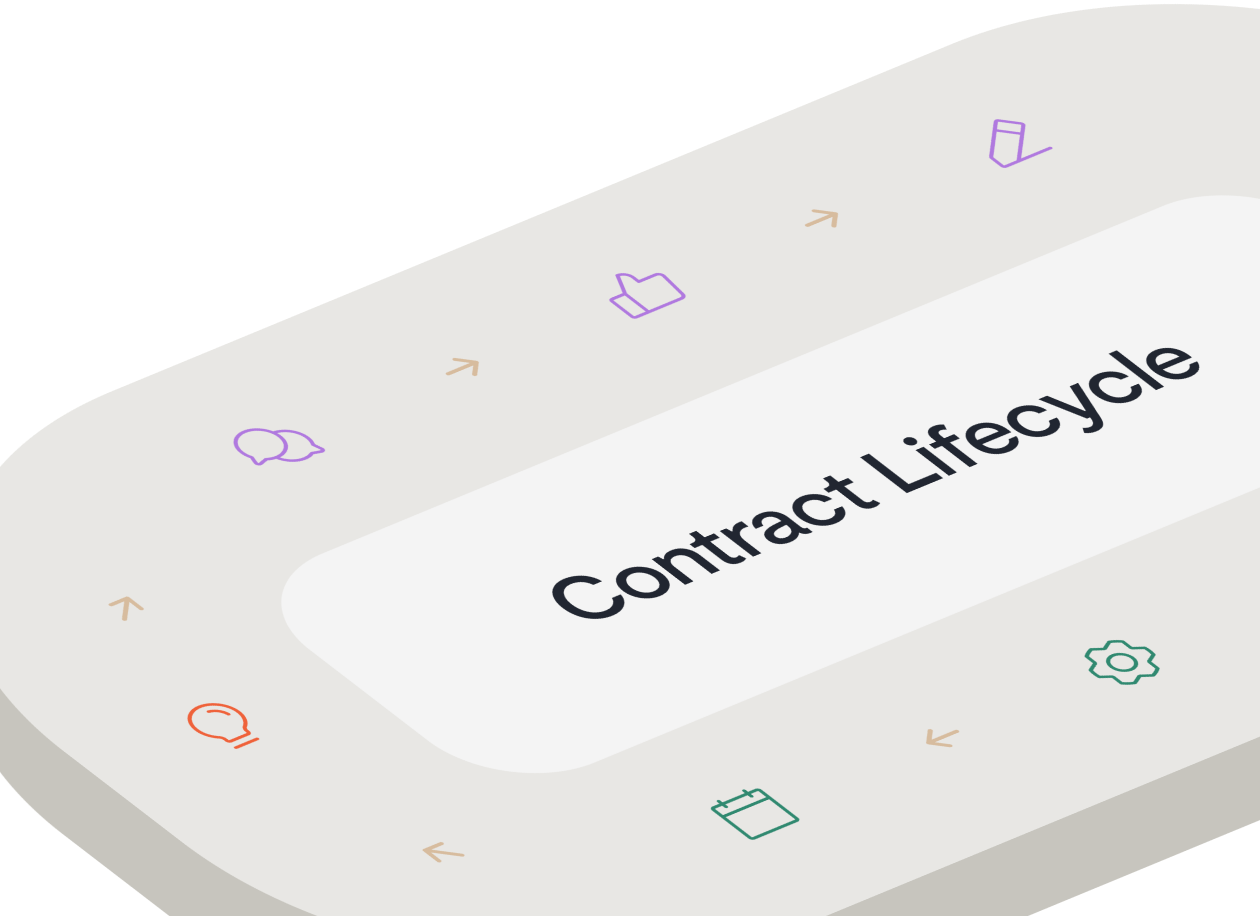
Contract lifecycle stages represent the complete journey from initial draft to final analysis.
The three essential stages are:
- Creation develops the initial agreement and terms
- Execution handles approvals, signatures, and activation
- Analysis tracks performance and obligations
Each stage contains multiple sub-processes that require careful coordination. Without proper management, teams struggle to track responsibilities, meet deadlines, and maintain compliance across all contract activities.
The problem is that traditional contract management scatters critical information across disconnected tools and teams.
Most companies rely on a patchwork of platforms: spreadsheets, Word documents, emails, and even paper files. This fragmentation creates three major problems that kill efficiency:
First, legal teams lack visibility into contract status across departments. procurement, HR, finance, and sales all handle contracts differently, making collaboration difficult.
Second, analytics become nearly impossible to collect. Without centralized data, teams can’t identify bottlenecks or measure improvement.
Third, work gets delayed by competing priorities. With 83% of legal departments facing rising demand, legal teams often address contracts only after clearing other backlogged work.
A centralized system solves these challenges by consolidating contract activities into a single platform.
Beyond the coordination problems, manual contract management consumes resources that could be spent on higher-impact work.
Teams spend hours tracking down document versions, chasing signatures through email, and manually entering data. These repetitive tasks prevent legal professionals from focusing on high-impact work like risk analysis and strategic negotiations.
Automation gets rid of these headaches. CLM software brings all your contract work into one place, automates routine tasks, and gives you a real-time view of the entire contract lifecycle.
The stages of the contract management process
Every company is a little different, but a solid contract management process generally follows these key stages. This isn’t just textbook theory; this is how it actually plays out when you have a system in place.
1. Request and intake
It all starts with a request. Someone from sales, procurement, or HR needs a contract. Instead of a vague email, a good process uses a simple intake form to gather all the necessary details upfront—who’s it with, what’s the value, are there any non-standard terms? This stops the endless back-and-forth for basic information.
2. Creation and drafting
Once you have the details, it’s time to create the contract. This is where templates are a lifesaver. Instead of starting from scratch, your team can automatically generate a first draft using pre-approved language. Modern CLM tools even use AI to pull the right clauses based on the intake form, so the draft is most of the way there from the start.
3. Collaboration and negotiation
This is where things usually get messy. Redlines fly back and forth in email, and version control becomes a nightmare. A structured process brings all collaboration into one platform. You can redline, comment, and approve changes in a single document. AI can even review counterparty paper and flag risky clauses or suggest fallback positions from your playbook, cutting review time from days to hours. This capability is becoming standard, with 80% of procurement teams now using AI during contracting, according to The State of AI in Procurement 2025 Report.
4. Approval and signature
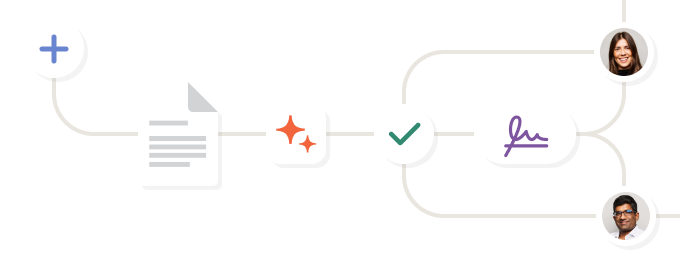
Your contract is ready, but who needs to sign off? A good process uses automated workflows to route the contract to the right people—finance, legal, department heads—based on rules you’ve set. Once approved, it’s sent for e-signature, and you get alerts along the way. No more manually tracking down approvers.
5. Storage and organization
After the contract is signed, it can’t just disappear into a folder. A central repository is key. Every signed agreement is automatically stored and tagged with key metadata like dates, value, and obligations. This makes everything searchable. Need to find all agreements that renew in the next 90 days? A quick search gives you the answer.
6. Reporting and analysis
This is where you start to see the strategic value. With all your contract data in one place, you can track contract process metrics like cycle times, bottlenecks, clause usage, and risk exposure. This data helps you prove the legal team’s value and make smarter decisions. For example, if you see that one specific clause is always heavily negotiated, maybe it’s time to rethink your standard language.
Renewal and termination management
Most contracts have an end date. As that date approaches, you have to decide whether to renew, renegotiate, or end the agreement based on your company’s goals and your relationship with the other party.
Here’s the thing: this stage is where a lot of value gets left on the table. Without a system to track renewal dates and termination windows, you might auto-renew a contract you wanted to renegotiate, or miss an opt-out deadline entirely. A good contract management process includes automated alerts well before these critical dates so you have time to make a strategic decision rather than a reactive one.
How to improve your contract management process
Contract management improvement requires addressing coordination gaps across teams, tools, and processes.
Most organizations spread contract work across multiple departments and platforms. This fragmentation prevents effective collaboration and creates these problems:
Teams miss critical deadlines because no single system tracks all obligations. Revenue opportunities disappear when contracts aren’t renewed on time.
Liability increases when compliance requirements fall through the cracks. Different teams using different processes create inconsistent risk management, which is particularly concerning given that 92% of contract management errors are human errors, according to The 2025 Legal Operations Field Guide.
To make real improvements, you need to change your system. Here are the actions that create more effective contract management processes:
- Standardize contracts using templates: Contract templates establish consistent legal language across all agreements. This reduces creation time from weeks to days while ensuring compliance. Teams can focus on customizing business terms instead of rebuilding standard clauses from scratch.
- Track contract approvals. Most contracts require review from multiple people, so it’s essential to have a clear way to manage approvals and any negotiations that happen along the way.
- Set key performance indicators (KPIs). To know if your process is working, you need to measure it. Track metrics like how long it takes to get a contract signed to see where you’re succeeding and where you need to improve.
- Analyze and monitor contract risks. Regularly review contracts for compliance to anticipate changes and minimize potential losses before they become real problems.
- Establish clear communication channels. A good communication system helps resolve disputes quickly and keeps the entire process running smoothly.
- Use your contract data. The information in your contracts can help improve future agreements. By collecting data on how contracts perform in a central repository, you can spot trends and make smarter decisions for new projects.
- Use a contract management platform. A dedicated system, like Ironclad, solves most common contract management issues by eliminating scattered processes and providing clear visibility, which helps you avoid unnecessary costs.
- Automate your process. In a digital world, automation is key to modern contracting. It keeps contracts up to date, simplifies collaboration, provides easy access to information, and ensures data security—all while cutting costs.
How contract lifecycle management (CLM) software can help
A contract lifecycle management (CLM) platform provides the technology foundation to make all these process improvements much easier to implement. It centralizes your contracts and data, makes documents accessible to the right people, and solves the common problems that arise when organizations haven’t yet digitized their contracting process.
Here’s what CLM software actually solves. Poor contract management creates six critical operational problems that drain resources and increase risk:
- Dispersed information prevents quick access to contract details. When agreements live across an average of 24 different systems, teams waste hours searching for specific terms or deadlines.
- Disorganized processes slow down deal velocity. Multiple departments using different systems create bottlenecks that delay signatures and revenue recognition.
- Limited transparency increases compliance risk. Teams can’t track who approved what changes or whether obligations are being met.
- Costly errors arise from manual processes. Misinterpreting legal language or missing renewal deadlines costs organizations thousands of dollars in missed opportunities or penalties.
- Missing analytics prevent process improvement. Without centralized data, teams can’t identify which contract types take longest or where bottlenecks occur.
- Time-intensive workflows reduce strategic capacity. Legal teams spend time on administrative tasks instead of high-value negotiations and risk analysis.
CLM software delivers ten measurable improvements to contract operations, and The 2025 Contracting Benchmark Report found an average 55% improvement across value metrics for organizations using Ironclad:
- Centralized information access saves search time. All contract details, versions, and communications live in one searchable repository instead of scattered across email and drives.
- Self-service capabilities reduce legal bottlenecks. Business teams can generate contracts from approved templates without waiting for legal to draft each agreement from scratch.
- Automated workflows accelerate approvals. Contracts route automatically to the right stakeholders based on value, type, or risk level.
- Integrated processes eliminate silos. Teams stop jumping between email, document storage, and signature tools to complete a single contract.
- Quick information retrieval supports faster decisions. Anyone with permissions can instantly access contract terms, obligations, or renewal dates.
- Lower overhead costs improve ROI. Automation reduces the time legal teams spend on routine contract tasks by up to 75%.
- Better risk visibility prevents compliance issues. Automated alerts notify teams about upcoming obligations, renewals, and potential risks before they become problems.
- Reduced data entry prevents errors. Information entered once flows automatically to all integrated systems, eliminating duplicate work and transcription mistakes.
- Enhanced collaboration aligns stakeholders. Contract managers, legal professionals, and procurement teams work from the same data and see the same contract status in real time.
- Consistent compliance protects the organization. Standard templates and approval workflows ensure all contracts meet legal requirements and company policies.
Transform your contracting with the right tools
Effective contract management requires systematic processes, centralized tools, and automated workflows.
The improvements outlined in this guide—standardized templates, automated tracking, clear performance metrics, and centralized repositories—transform contract management from a reactive bottleneck into a strategic advantage.
Organizations ready to modernize their contract processes can start with CLM software that handles the technical complexity while keeping contracts accessible to all stakeholders.
Request a demo today to see how teams reduce contract cycle times by up to 93% while maintaining compliance and reducing risk.
Frequently asked questions about the contract management process
What are the 5 steps of contract management?
People often break it down into five core steps: 1) creation, 2) negotiation, 3) approval, 4) execution (signing), and 5) post-execution management (which includes storage, compliance, and renewals). It’s a simple way to think about the contract’s journey from start to finish.
What are the 6 or 7 stages of contract management?
For a more detailed view, some people use six or seven stages: 1) planning/intake, 2) authoring, 3) negotiation, 4) approval, 5) execution, 6) obligation management/compliance, and 7) renewal/close-out. This just adds more detail to the beginning and end of the process, but the core idea is the same.
What are the 5 C’s of a contract?
This is a classic from contract law basics. The five C’s usually refer to: Capacity (are the parties legally able to enter a contract?), Consent (was agreement freely given?), Clarity (is the language clear and unambiguous?), Consideration (is something of value being exchanged?), and Certainty (are the terms specific enough to be enforceable?). It’s a good mental checklist for contract validity.
Ironclad is not a law firm, and this post does not constitute or contain legal advice. To evaluate the accuracy, sufficiency, or reliability of the ideas and guidance reflected here, or the applicability of these materials to your business, you should consult with a licensed attorney. Use of and access to any of the resources contained within Ironclad’s site do not create an attorney-client relationship between the user and Ironclad.