














Renewal and Upsell Contracts: Best Practices for Your Business
Renewal and upsell contracts deliver measurable value when managed effectively. This guide covers the strategies and tools that help you manage the process more efficiently and close more agreements.

Table of Contents
- What are renewal and upsell contracts?
- Who should own renewals and upsells
- How to calculate renewal and upsell rates
- How to create renewals and upsells
- Managing renewals and upsells
- Limitations of renewals and upsells
- Automating workflows for renewal and upsell contracts
- Product features that help
- Transform your renewal and upsell process
- Frequently asked questions about renewal and upsell contracts
Want more content like this? Sign up for our monthly newsletter.
Key takeaways:
-
Prioritize renewal and upsell contracts over new customer acquisition, as they cost only 28% of what it takes to acquire a new client on average, making them essential for sustainable and cost-effective revenue growth.
-
Establish clear ownership boundaries by assigning Customer Success to handle standard renewals while Sales manages major upsells and expansions that require complex value-based selling motions.
-
Focus on helping customers realize the actual value of your services throughout the contract term, as companies with sophisticated value realization practices achieve Net Revenue Retention rates seven percentage points higher than their peers.
-
Implement automated workflows and centralized contract repositories to eliminate manual tracking across fragmented systems and ensure no renewal opportunities fall through the cracks.
How often have you watched a valuable customer slip away at renewal time? You thought the relationship was solid, the value was clear, but somehow the contract didn’t get renewed. Maybe it got lost in someone’s inbox, or a competitor swooped in with a flashy new offer while you were focused elsewhere.
Contract renewal is an integral part of many companies’ business models. Managing all the moving pieces involved in the renewal process can be challenging, especially when you add upsells to the mix.
The effort is worth it. Renewal and upsell contracts cost four to five times less than new customer acquisition. This cost advantage makes them essential for sustainable growth.
Renewal and upsell contracts deliver measurable value when managed effectively. This guide covers the strategies and tools that help you manage the process more efficiently and close more agreements.
You’ll learn:
- What renewal and upsell contracts are and why they matter for your business
- Who should own the renewal and upsell process in your organization
- How to calculate renewal and upsell rates to measure performance
- Best practices for creating and managing renewal contracts
- How automation eliminates manual tracking and improves close rates
What are renewal and upsell contracts?
A renewal contract extends an existing agreement beyond its original expiration date. When a contract you previously signed reaches the end of its term, you have the option to renew it under updated terms.
An upsell contract adds additional services or products to an existing customer agreement. Instead of just continuing what you already have, the client expands their relationship with your business.
A new contract establishes the initial relationship. It’s the first agreement you sign with a client for whatever services they choose.
These three contract types form the foundation of most subscription-based businesses.
Renewal contracts focus on keeping your current clients on board. When you’re working to renew contracts, you should be building relationships with clients, so they remember why they chose your business in the first place. Keeping your customers gives your organization security and stability.
When you upsell, you not only retain the customer but convince them to work more closely with your business. The additional services the customer accepts mean extra revenue for your business without the work of finding new prospects. Considering that renewing current contracts costs just 28% of what it takes to acquire a new client on average, upselling is an excellent and cost-effective way to grow revenue.
Renewal contracts typically update three key elements from the original agreement:
- Duration defines the new contract term with specific start and end dates.
- Deliverables clarify what services you’ll provide, especially important for upsells that add new benefits.
- Pricing reflects current costs, often adjusted for inflation or expanded services.
Who should own renewals and upsells
This is one of those questions that trips up a lot of teams. When a customer is up for renewal, who handles it? Sales? Customer Success? What about an upsell opportunity that comes up during a support call? If you don’t have clear lanes, you get confusion, missed opportunities, and a clunky customer experience.
There’s no single right answer for every company, but here’s a common-sense way to think about it:
- Customer Success (CS) often owns the renewal. They have the day-to-day relationship with the customer. They understand the customer’s health, their product usage, and their goals. Giving them ownership of the standard renewal process makes sense. It feels like a natural continuation of the partnership, not a hard sell.
- Sales typically owns major upsells and cross-sells. When a renewal involves a significant expansion—like moving to a higher enterprise tier or adding a whole new product line—it often requires a more complex, value-based sales motion. This is where your Account Executives (AEs) or expansion-focused sales reps should step in. They’re trained for it.
The key is to define the handoff points. For example, CS might handle any renewal that’s within a 10% price increase, but anything larger gets flagged for sales. The important thing is that everyone understands the process. This is where having your contract data and workflows in one place is critical. With a contract lifecycle management (CLM) solution, you can build rules that automatically route a renewal to the right person based on contract value, product type, or potential expansion size. It clarifies responsibilities and ensures no opportunity is missed.
How to calculate renewal and upsell rates
Talking about renewals and upsells is great, but leadership wants to see the numbers. Talking about renewals and upsells is great, but leadership wants to see the numbers. There are a few key metrics, but don’t get bogged down in complex formulas. Here’s what you really need to know.
The most important metric is Net Revenue Retention (NRR). This tells you how much your revenue from existing customers has grown or shrunk over a period, including upsells, downsells, and churn. If your NRR is over 100%, it means you’re making more money from your existing customers than you’re losing from them. Companies selling subscription software with high NRR grow 2.5x faster than their low-NRR counterparts.
Think of it this way: NRR answers the question, “If we didn’t sign a single new customer this year, would we still grow?”
Another useful one is Gross Revenue Retention (GRR). This metric looks only at renewals and churn, ignoring any expansion revenue from upsells. It tells you how sticky your product is. A high GRR means customers are staying and continuing to pay for what they originally bought.
The problem is, pulling these numbers is a challenge if your data is scattered. You need to know the starting value of a contract, its renewal date, and its new value post-renewal. When this information lives in different spreadsheets, Salesforce, and your finance system, it’s a massive manual effort. Having a central contract repository where all this data is automatically tracked makes it possible to actually calculate these metrics without a team of analysts.
How to create renewals and upsells
Creating successful renewal and upsell contracts requires a strategic approach that maintains customer relationships throughout the contract lifecycle. Three core practices form the foundation of effective renewal and upsell strategies.
- Stay in touch with contracted customers throughout the agreement term. You can’t ignore customers for the length of their contract and expect them to feel connected to your brand. The sales process doesn’t end when the original contract is signed. Instead, stay in contact with the customers and ensure they’re satisfied with what they’ve received. At a minimum, you need to keep track of which contracts are ready for mid-year check-in meetings and which are up for renewal in the next 60 days.
- Focus on value realization. You can sell and sell and sell your company’s services, but your clients will only truly understand their worth once they use them. Help your customers realize the actual value of your services by managing their expectations and providing them with data about how you’ve helped them achieve their goals. McKinsey’s research shows companies with sophisticated value realization practices produce NRR seven percentage points higher than peers.
- Highlight features and benefits. Whether you want to upsell a contract or simply renew it, you can spotlight the benefits and features your company offers. Talk about new features coming out soon, the improvements you’ve already made, and the help you provide that the client can’t find anywhere else.
By building a relationship with the customer, helping them understand what they’ve already gained from your services, and showing them how you’ll continue to assist in the future, you can create renewals and upsells more effectively.
Managing renewals and upsells
Even with a solid strategy in place, the operational side of renewal and upsell management can quickly become overwhelming. There are many moving parts, from maintaining regular contact with each client to collecting data to demonstrate how you’re helping them achieve their goals. Without the right systems, these critical relationships can fall through the cracks—a costly oversight considering organizations lose an average of 8.6% of total spending a year to cost leakage, according to The 2025 Contracting Benchmark Report.
Tracking contract timelines creates scheduling complexity. Effectively managing contract renewals requires tracking where every client is in their contract period. Established companies likely have contracts up for renewal every month, requiring regular check-ins and renewal meetings. Just managing these meetings alone can consume hours of payroll and creates risk of forgetting someone.
Disconnected systems eliminate transparency. Your company likely stores contract information and renewal deadlines in different systems that don’t communicate with each other — contract data is typically fragmented across 24 different systems. This isolation forces manual coordination between databases and schedules. The result is a complete lack of transparency, making it harder to align your teams to get to revenue faster.
Limitations of renewals and upsells
Even the best renewal and upsell strategies face real-world challenges that can prevent you from closing deals.
Competitive pressure creates uncertainty around renewals. Clients in crowded markets face constant courting from your competitors. You can build strong relationships, but some clients will still choose tempting first-year offers from other companies. Renewals and upsells are never guaranteed.
Time and effort requirements create operational challenges. Important client renewals get missed without proper tracking systems. You must monitor agreements and reach out well before expiration dates to secure renewals on time.
Automating workflows for renewal and upsell contracts
Workflow automation simplifies the renewal process by eliminating manual tracking and reminders, allowing you to create scalable closing processes. It’s no surprise that tracking and managing contractual commitments is the most common AI contracting use case across all industries, as noted in The State of AI in Procurement 2025 Report. The most effective automation approach uses templatable workflows that standardize your renewal process.
A templatable workflow allows you to design the workflow you want to follow for every contract, then apply that template to all the contracts that fit your criteria. You can create different templates for renewing and upselling contracts depending on how you design your process. These templates can cover everything, from knowing who’s in charge of various process steps to sending automated reminders when it’s time for someone to take the next step.
Of course, templatable workflows only work if your systems can communicate with each other. If your contracts, renewal dates, and customer information are all siloed off from each other, you can’t implement effective automation.
This is why an all-in-one CLM solution is invaluable. A CLM acts as a central repository for your entire contracting process, from landing clients to renewing and upselling contracts. A good CLM will offer complete transparency into the process, so there’s never doubt about the status of your contracts. There’s a reason why the most efficient businesses routinely store 78% of their contracts in a centralized, searchable database.
Product features that help
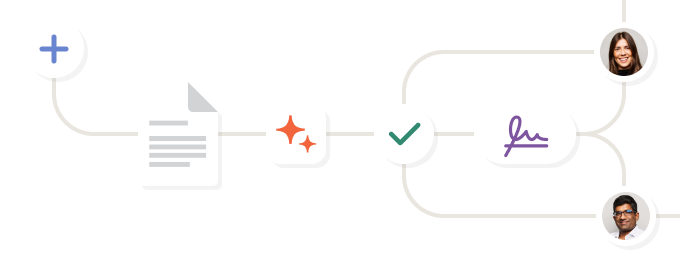
Ironclad’s Workflow Designer makes creating templatable workflows straightforward. Teams can design workflows that fit their actual processes. Upload a contract template and tag the fields that need to be filled out by the requestor. You can customize the workflow as necessary by adding approvers, signers, and even conditional contract clauses.
Digital contract management provides transparency for renewals and upsells. You can check every contract in a single place. Ironclad’s contract repository lets you easily monitor which contracts are up for renewal soon. The CLM lets you track the renewal process at a glance for every client, every time. You’ll never miss a renewal opportunity again.
Transform your renewal and upsell process
Renewals and upsells drive sustainable revenue growth at a fraction of new customer acquisition costs. The challenge is managing the process at scale without overwhelming your team.
Success requires three elements working together. Clear tracking systems ensure no renewal falls through the cracks. Automated workflows eliminate manual reminders and coordination. Centralized contract repositories provide instant visibility into every agreement’s status.
Teams using Ironclad’s contract management platform experience these benefits firsthand. Our customers automate renewal workflows, track obligations automatically, and maintain complete visibility across their contract portfolio. Request a demo today to learn how Ironclad can help you close more renewals and upsells.
Frequently asked questions about renewal and upsell contracts
What are the rules for auto-renewal contracts?
The biggest rule is clarity. The contract has to clearly state that it will auto-renew, when, and for how long. You can’t bury the auto-renewal clause in dense legal text. Most regulations also require you to send a notice to the customer before the renewal happens, giving them a chance to opt out. If the price is going to change, that needs to be communicated clearly, too. A good CLM with automated alerts is essential here—it ensures you never miss a notification window and can track all your auto-renewing agreements in one dashboard.
What are some good upselling examples?
It’s all about adding more value. A classic example is moving a customer from a standard software tier to a premium one that has more features. Another is increasing user seats as their team grows. You could also sell them an add-on module, like an AI-powered analytics feature that complements their core product. The key is that the upsell should solve a growing pain for the customer; it shouldn’t just be about selling them more stuff.
What does “renewing a contract” mean?
Simply put, it means extending the agreement you already have. Both sides agree to continue the business relationship. Sometimes the terms are exactly the same, and other times you might make small adjustments, like an updated price or minor changes to the service level agreement (SLA). It’s different from creating an entirely new contract; you’re building on the foundation you already have.
Ironclad is not a law firm, and this post does not constitute or contain legal advice. To evaluate the accuracy, sufficiency, or reliability of the ideas and guidance reflected here, or the applicability of these materials to your business, you should consult with a licensed attorney. Use of and access to any of the resources contained within Ironclad’s site do not create an attorney-client relationship between the user and Ironclad.