
















Table of Contents
- What is the purpose of a software license agreement?
- Why software license agreements are important
- When do I need a software license agreement?
- Types of software license agreements
- What are the parts of a software license agreement?
- Key clauses and components to include
- How do you create a software license agreement?
- Managing software license agreements
- Streamline your software license agreement process
- Frequently asked questions about software license agreements
Want more content like this? Sign up for our monthly newsletter.
Key takeaways:
-
Review software license agreements thoroughly before signing to understand usage restrictions, payment terms, and compliance requirements, as overlooked clauses can lead to unexpected access revocation or costly violations.
-
Implement a contract lifecycle management system to centralize all software agreements in one searchable location, preventing the average 8.6% contract value loss that companies experience due to poor management and fragmented storage.
-
Negotiate critical clauses including license grant scope, limitation of liability, and termination terms before finalizing any agreement, especially for enterprise software purchases or applications handling sensitive data.
-
Utilize standardized templates and automated workflows to create consistent software license agreements, ensuring your team can quickly locate renewal dates, usage limits, and other key terms across your entire software portfolio.
Picture this: you’re three months into using new project management software when suddenly your access gets revoked. Turns out, the license agreement you clicked through had usage restrictions that nobody on your team understood. Now you’re scrambling to find alternative tools while dealing with compliance issues that could have been avoided.
A software license agreement is a legal contract that grants you permission to use software without transferring ownership. The software creator retains intellectual property rights while giving you specific usage rights under defined terms and conditions.
This arrangement benefits both parties. Software companies can protect their code while generating revenue from multiple users. License holders get access to powerful tools at a fraction of the cost of purchasing full ownership rights.
The scope of your rights depends on what’s negotiated. You might get permission to use the software on a specific number of devices, modify code for internal purposes, or distribute it to your team members. What you can’t do is usually just as important—like reverse engineering the software, sharing it publicly, or using it beyond the agreed terms.
What is the purpose of a software license agreement?
Software license agreements serve a specific purpose—they define exactly which rights each party retains and which rights transfer through the license.
Both parties negotiate these terms to protect their interests. Software creators typically protect themselves from liability for how users apply their products. They also specify whether the software can be embedded into other products or must remain standalone.
These negotiations ensure everyone understands the boundaries. You know what you can and can’t do with the software, and the creator knows their intellectual property stays protected.
Why software license agreements are important
Do you really need a formal agreement just to use software? Yes—and here’s why it matters more than you might think.
Software license agreements protect both sides of the transaction. For the software provider, they establish clear boundaries around intellectual property, limit liability, and define acceptable use. For the licensee, they guarantee certain rights, outline what support or updates you’ll receive, and clarify what happens if something goes wrong.
Without these agreements in place, disputes become messy. What happens if the software doesn’t perform as expected? Who’s responsible if there’s a security breach? Can you resell your access to someone else? These questions might seem hypothetical until you’re actually facing them—and by then, it’s too late to negotiate terms.
The importance extends beyond just legal protection. Software license agreements also help organizations manage compliance, track their software assets, and budget appropriately for renewals. When you’re dealing with dozens or hundreds of software subscriptions across an organization, having clear, well-documented agreements becomes essential for keeping everything organized and on track.
When do I need a software license agreement?
You need a software license agreement whenever you acquire or distribute commercial software. These agreements are non-negotiable components of software transactions—they exist whether you actively review them or not.
They become particularly critical in two scenarios. First, software as a service (SaaS) arrangements require ongoing license management since your access depends on continuous compliance. These aren’t quick deals to sign, either—SaaS agreements typically require about 40 days to execute, according to The 2025 Contracting Benchmark Report. Second, enterprise software purchases often involve negotiated terms that directly impact how your organization can use the product.
You’ll want to pay closer attention to software license agreements when:
- You’re procuring software for your organization rather than personal use
- The software will handle sensitive data or integrate with critical systems
- You need custom terms around data privacy, security, or compliance
- The contract value is significant enough to warrant negotiation
- You’re licensing software to distribute to your own customers
Types of software license agreements
Once you start looking, you’ll see these agreements everywhere, but they aren’t all the same. They generally fall into a few common buckets, and knowing the difference helps you understand what you’re actually agreeing to.
- Proprietary license: This is the classic model. The software is the exclusive property of its owner, and the agreement lays out strict rules on what you can and can’t do. You’re buying a right to use it, not own it.
- Open-source license: This is a different world entirely. These licenses let you view, modify, and even distribute the source code. They’re built on community collaboration, but they still have rules—some require you to share your changes, for example.
- Perpetual license: You pay a one-time fee upfront and get to use the software indefinitely. It sounds great, but it often doesn’t include ongoing updates or support unless you pay for a separate maintenance plan.
- Subscription license (SaaS): This is the model most of us are used to now—subscription-based licensing accounts for over 48% of global revenue. You pay a recurring fee (monthly or annually) for access to the software, which usually includes updates and support. It’s a license to use the service for a specific term.
Each type comes with its own set of trade-offs. Perpetual licenses require more upfront capital but can be more cost-effective over time. Subscription licenses spread costs out but mean you’re always paying to maintain access. Open-source software might be free to use, but you’ll need to carefully review the license terms to understand your obligations.
What are the parts of a software license agreement?
A software license agreement contains several essential components that define the business relationship. Each one has a specific job to do, both legally and practically.
The core elements you’ll find in most agreements include:
- Definitions: Clarifies key terms used throughout the agreement so both parties are working from the same understanding
- License grant: Specifies exactly what rights the licensee receives—the scope, duration, and permitted uses
- Payment terms: Outlines pricing, payment schedules, and what happens if payments are missed
- Support and maintenance: Describes what ongoing services are included, such as updates, bug fixes, or technical support
- Term and renewal: Establishes how long the agreement lasts and what happens when it expires
Key clauses and components to include
Whether you’re the one buying the software or selling it, a few key clauses do all the heavy lifting. Getting these right is what keeps relationships clear and avoids problems down the road. Here’s what to look for:
- License grant: This is the core of the agreement. It spells out exactly what the user is allowed to do—use the software on a certain number of devices, for a specific purpose, or within a certain geographic area. If it’s not in the grant, you can’t do it.
- Restrictions: This is the flip side of the grant. It defines what the user is explicitly forbidden from doing, like reverse-engineering the software, renting it out to others, or removing copyright notices.
- Intellectual property (IP) ownership: This clause makes it crystal clear that the software provider owns the underlying code and all related IP. The user is just getting a license, not an ownership stake.
- Term and termination: This defines how long the license is valid and what happens if one party wants to end the agreement early. It covers things like renewal terms and the process for terminating for cause, like a breach of contract.
- Warranties and disclaimers: The provider might offer a warranty that the software will perform as described for a certain period. Just as important are the disclaimers, where the provider states what they are not responsible for.
- Limitation of liability: This is a big one for risk management. It sets a cap on the amount of money the software provider could be on the hook for if something goes wrong. Without this, the financial risk could be enormous.
When reviewing or negotiating these clauses, it helps to have your legal team involved. The language can be dense, and small wording changes can have significant implications for your organization’s risk exposure.
How do you create a software license agreement?
There are two main approaches to software license agreements. The first involves standard, non-negotiable terms—think of the mass-market software where you can only accept or decline the entire agreement. The second involves negotiated agreements where both the buyer and seller can propose and modify terms—a frequent occurrence, as the report shows that 70% of software licensing agreements undergo negotiation.
For negotiated agreements, you typically start with a template that reflects your standard terms and build from there. Both parties propose their requirements, and through discussion and compromise, you reach an agreement that works for everyone. For example, you might agree to stagger payments over three years while the vendor agrees to provide enhanced data security measures.
For negotiated agreements, the process typically looks like this:
- Start with a template that reflects your standard terms and risk tolerance
- Identify the non-negotiable terms versus areas where you have flexibility
- Exchange drafts with the counterparty, marking up areas of disagreement
- Work through redlines until both parties reach acceptable terms
- Route the final agreement through appropriate approvals before signing
The key is having a clear process and understanding your priorities before negotiations begin. What terms are must-haves? Where can you compromise? Having these answers ready makes the negotiation smoother for everyone involved.
Managing software license agreements
As you accumulate software licenses, keeping track of them becomes increasingly challenging—WorldCC and Deloitte research found that companies lose an average of 8.6% of a contract’s value due to poor management. Each agreement comes with different terms, renewal dates, and usage restrictions. When you need to find specific information—like whether you can add more users or when your next payment is due—you might find yourself digging through email threads and file folders. Modern contract management systems solve these tracking challenges by centralizing all your agreements in one searchable location.
Common challenges with software license agreements
Software license agreements face practical limitations that affect their effectiveness. Understanding these constraints helps you manage agreements more strategically.
Length and complexity create comprehension barriers. Comprehensive agreements that attempt to address every possible scenario often become too long for practical review. This length makes it harder to locate specific terms when you need them.
Unforeseen situations expose gaps. No agreement can predict every possible use case or business scenario. When novel situations arise, the contract may not provide clear guidance on how to proceed.
Storage and tracking become challenging. The more detailed an agreement becomes, the more difficult it is to maintain organized records and track specific obligations across multiple contracts.
Traditional contract management challenges
Traditional contract management systems create significant obstacles for software license agreement tracking. These limitations affect your ability to access and use critical contract information.
Fragmented storage systems prevent unified access. Contracts end up scattered across filing cabinets, individual computers, email archives, and various file formats. This fragmentation makes it nearly impossible to get a complete picture of your software licensing obligations. Some agreements exist only in physical form while others live in digital systems that don’t communicate with each other.
Isolated processes prevent comparative analysis. Each contract negotiation happens in a vacuum without reference to previous agreements. This isolation prevents you from benchmarking vendor rates, identifying favorable terms from past negotiations, or building institutional knowledge about licensing patterns.
Limited transparency blocks information use. Finding a specific contract is only half the battle—extracting usable information from dense legal language requires significant time and expertise. Important details about renewal dates, usage restrictions, and payment terms remain locked in documents that few people can efficiently parse.
Modern contract management solutions
Digital contract management systems transform how organizations handle software license agreements by centralizing contract data in a single, searchable platform. These systems address the core weaknesses of traditional approaches—fragmentation, isolation, and opacity.
Modern platforms consolidate all your software agreements regardless of where they originated. Everyone who needs access gets it through appropriate permissions. You can analyze licensing patterns, compare vendor terms, and use that information to make smarter software purchases.
Here’s what this means in practice: Instead of maintaining separate files and systems, you get unified access to all your contracts. When you need information about a specific vendor or contract term, you can search across your entire portfolio instantly. The comparative analysis capabilities let you benchmark vendor terms and identify opportunities for better negotiations.
Automated workflows and templates
Using templates means every software agreement follows the same structure, so your team always knows where to find key information like renewal dates or usage limits. Smart contract templates guide you through agreement creation by prompting you for necessary information at the right moments. You can customize sections based on specific vendor requirements while maintaining standardized language for critical terms.
Template-based systems do more than just create new agreements. They also turn your existing contracts into searchable information by automatically tagging key details. You can instantly search and compare across your entire portfolio by contract type, value, signatories, expiration dates, or any other relevant parameter.
Reusing proven templates helps you create new contracts much faster. New agreements inherit the structure and successful clauses from your existing contracts. This consistency means team members always know where to find specific information, regardless of which software agreement they’re reviewing. Over time, you’ll identify which terms work best and continuously improve your negotiation positions.
Workflow automation capabilities
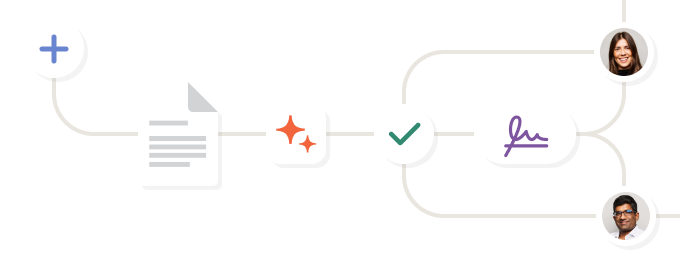
Instead of manually emailing drafts and chasing down signatures, a workflow designer handles the entire process for you, automatically routing the agreement to the right people at the right time. With 83% of legal departments facing rising demand, this automation eliminates the manual coordination that typically bogs down software license agreement execution.
The system shows you the exact status of any contract at a glance. You see exactly which steps remain incomplete and who needs to take action next. Multiple team members can collaborate on the same agreement simultaneously without version control conflicts.
No technical expertise required. Dropdown menus and pre-configured sections guide users through complex contract creation. Anyone on your team can generate compliant software license agreements by following the system’s prompts. This accessibility means legal teams spend less time on routine agreements and more time on strategic negotiations.
Streamline your software license agreement process
If you’re dealing with more than a handful of these agreements, you know the real challenge isn’t just signing them—it’s managing them. Keeping track of renewal dates, usage rights, and payment terms across dozens of spreadsheets and email chains is a recipe for missed deadlines and unnecessary risk.
This is where a contract lifecycle management (CLM) platform becomes essential. Instead of treating contracts as static documents that get filed away, a CLM turns them into living, searchable data. You can set up automated alerts for renewals, create workflows to route agreements for approval, and pull reports on your obligations in minutes, not hours.
By centralizing all your software licenses in one place, you ensure everyone is working from the same, up-to-date information. Your legal, procurement, and IT teams can all work from the same information, which makes negotiation smarter and compliance easier. It’s about moving from a reactive, paper-chasing process to a proactive, strategic approach to managing your software assets.
AI is also changing how teams handle software license agreements. Modern CLM platforms can use contract review AI to extract key terms from agreements, flag unusual clauses, and even suggest redlines based on your preferred positions. It’s no wonder that The State of AI in Legal 2025 Report found contract review to be the most impactful AI use case for legal professionals. This means less time spent on manual review and more time focused on the negotiations that actually matter.
If you’re ready to move beyond manual spreadsheets and scattered storage, request a demo today to see how contract management software can put you in control of your software licensing operations.
Frequently asked questions about software license agreements
What’s the difference between a software license agreement and an end-user license agreement (EULA)?
Think of a EULA as a specific type of software license agreement. EULAs are typically non-negotiable, click-through agreements presented to individual users before they install or use mass-market software. A broader software license agreement, on the other hand, is often a negotiated document between two businesses, like a software provider and an enterprise customer, and can be much more detailed and customized.
Is a software license the same as a service-level agreement (SLA)?
No, they serve different purposes, though they are often used together. The software license agreement grants the right to use the software. A service-level agreement (SLA) defines the level of service you can expect from the provider, covering measurable metrics like uptime, support response times, and performance benchmarks. For SaaS products, you’ll almost always see both.
Why is software licensed instead of sold?
It comes down to protecting intellectual property. If a software company sold its code outright, they would lose control over it. The buyer could copy, modify, and resell it, destroying the provider’s business model. Licensing allows the company to retain ownership of its valuable IP while granting specific, limited rights to many different customers. It’s the legal framework that makes the entire software industry possible.
Ironclad is not a law firm, and this post does not constitute or contain legal advice. To evaluate the accuracy, sufficiency, or reliability of the ideas and guidance reflected here, or the applicability of these materials to your business, you should consult with a licensed attorney. Use of and access to any of the resources contained within Ironclad’s site do not create an attorney-client relationship between the user and Ironclad.