













Table of Contents
- What is contract cycle time?
- Why contract cycle time matters
- What causes long contract cycle times?
- Who owns contract cycle time?
- How to measure contract cycle time
- How to reduce contract cycle time without increasing risk
- Frequently asked questions about contract cycle time
Receive the latest updates on growth and AI workflows in your inbox every week
Key takeaways:
- Measure contract cycle time by breaking it down into specific stages (intake, drafting, review, negotiation, approval, execution) and tracking wait time separately from work time to pinpoint where delays actually occur rather than just tracking total elapsed days.
- Standardize intake with self-service forms requiring complete information upfront, maintain a pre-approved template library, and implement negotiation playbooks that define which terms are flexible to eliminate the most common delays before drafting begins.
- Automate approval workflows that route contracts based on type and value while enabling parallel reviews, and integrate eSignature tools directly into your contract lifecycle management platform to remove handoff delays at every stage.
- Establish shared service-level agreements between legal, sales, procurement, and finance teams that define target cycle times for each contract type, recognizing that cycle time affects revenue recognition and forecasting across the entire business.
Contract cycle time measures how long it takes to move a contract from initial request to final signature, and it’s one of the clearest indicators of whether your contracting process is helping or hurting the business. This guide walks you through what contract cycle time actually is, why it matters beyond the legal team, how to measure it accurately, and the specific changes that cut days or weeks off your timeline without adding risk.
What is contract cycle time?
Contract cycle time is the total number of days it takes a contract to go from first request to final signature. This means every minute counts—from the moment someone asks for a contract to the moment every party has signed it.
Here’s the thing most people miss: cycle time includes all the waiting, not just the working. A contract might only need a couple hours of actual legal work, but if it’s bouncing between inboxes for three weeks, your cycle time is three weeks.
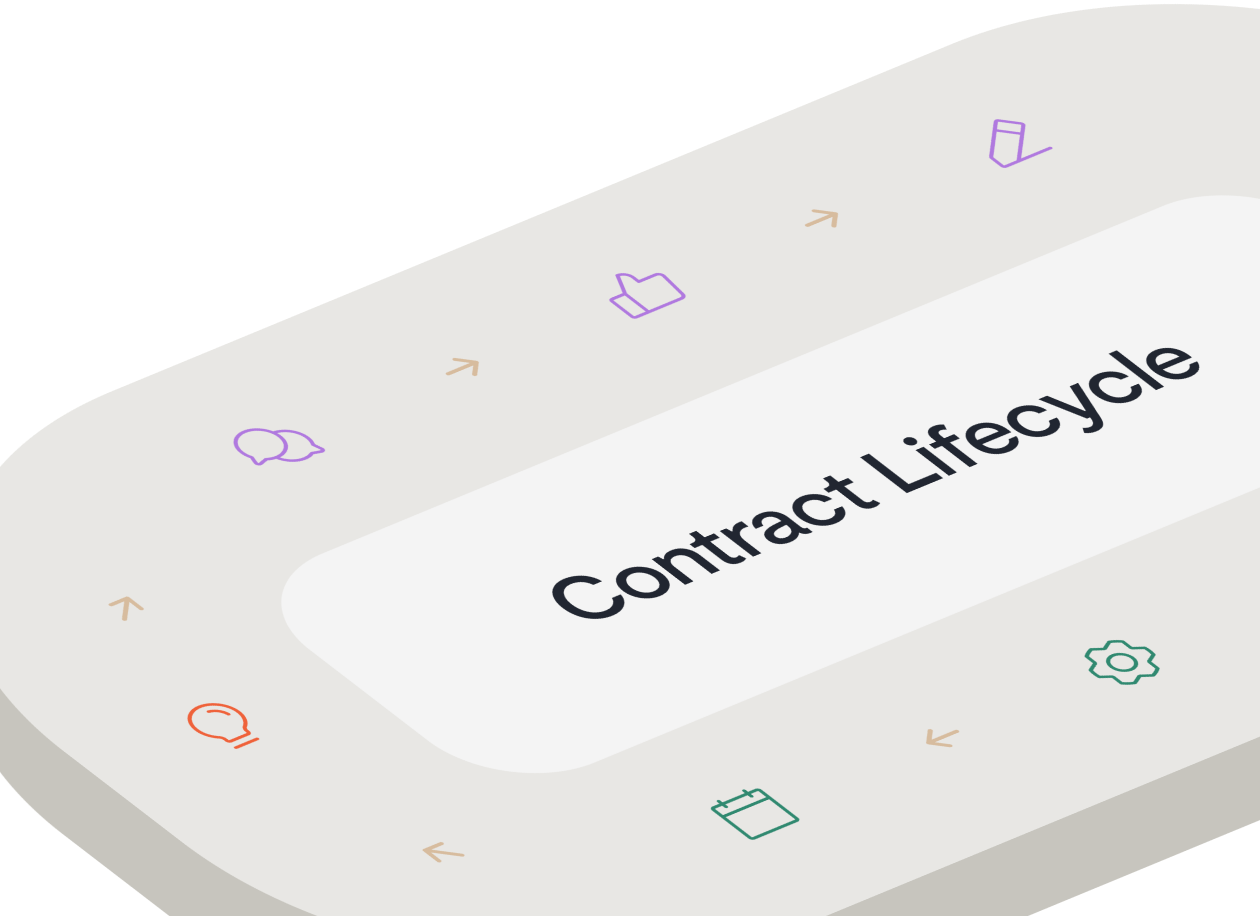
Every contract passes through a series of stages on its way to execution:
- Intake: Someone submits a request for a new contract
- Drafting: A first version gets created, usually from a template
- Internal review: Your legal, finance, or other teams review and comment
- Negotiation: Redlines go back and forth with the counterparty (the other party signing the contract)
- Approval: The right people inside your organization give final sign-off
- Execution: Everyone signs
Each of those stages adds to your total cycle time. And if you’ve ever wondered why a “simple” contract took two weeks, the answer is almost always the gaps between those stages—not the stages themselves.
Why contract cycle time matters
You might think of contract cycle time as a legal team problem. It’s not. It’s a business problem that touches revenue, relationships, and how leadership views your team.
When contracts drag on, sales deals slip into the next quarter. Procurement can’t get vendor agreements in place for projects that are already behind schedule. Finance can’t forecast revenue because nobody knows when contracts will actually close. And the legal team? They get labeled as the bottleneck, even when the delays are happening somewhere else entirely.
- Revenue gets delayed: Every extra day in the contracting process is a day your organization isn’t recognizing that deal’s value. For sales-heavy companies, slow contracts directly shrink quarterly numbers—57% of business development professionals report that contracting inefficiencies delay revenue recognition. In fact, poor contract management can cause organizations to lose between five and nine percent of their annual revenue, according to The 2025 Contracting Benchmark Report.
- Forecasting breaks down: If leadership can’t predict when contracts will close, budgeting and planning become guesswork.
- Relationships suffer: Vendors and partners notice when your contracting process is slow. Over time, that friction can push them toward competitors who move faster.
- Risk increases quietly: The longer a contract sits open, the more likely it is that regulations change, market conditions shift, or someone on the deal moves to a different role.
When cycle times are short and predictable, the legal team earns trust as a business partner. When they’re not, legal gets stuck with a reputation it doesn’t deserve.
What causes long contract cycle times?
Most of the time that inflates contract cycle time isn’t spent on careful legal analysis. It’s lost to messy handoffs, missing information, and disconnected tools—contract data is fragmented across 24 different systems on average in organizations.
The bottlenecks tend to be the same from one organization to the next. Requests come in through email or Slack with half the details missing, so legal has to chase down information before drafting even starts. That alone can add days.
Without a standard set of templates and a negotiation playbook—a document that defines which contract terms are flexible and which aren’t—every contract becomes a one-off project. Your team ends up drafting from scratch or hunting for the most recent version of a template that may or may not be current.
Approval routing is another common culprit. If nobody knows whose turn it is to review, contracts sit in inboxes until someone sends a follow-up email. Multiply that by three or four approvers and you’ve added a week without anyone doing a minute of work.
Negotiation creates its own drag when teams are emailing Word documents back and forth. Version confusion wastes time, and it creates real risk when someone signs a version that doesn’t reflect the latest edits.
Even at the finish line, disconnected eSignature tools or wet-signature requirements add friction right when the deal should be closing.
Who owns contract cycle time?
The legal team usually owns the metric, but they can’t control it alone. Every team that touches a contract influences the number.
- Legal sets the standards—templates, playbooks, risk thresholds—and owns the reporting
- Sales kicks off contracts and is responsible for submitting complete deal information at intake
- Procurement manages vendor and supplier agreements, often with separate approval chains
- Finance weighs in on commercial terms, payment schedules, and anything that affects revenue
- Legal ops or RevOps builds the workflows, dashboards, and integrations that keep everything connected
The best setup is a shared service-level agreement (SLA)—a commitment between legal and business teams on how long each contract type should take. An NDA might have a two-day SLA, while an enterprise master service agreement (MSA) might allow two weeks. Without that kind of shared accountability, cycle time becomes everyone’s complaint and nobody’s responsibility.
How to measure contract cycle time
You can’t fix what you can’t see. Measuring contract cycle time sounds straightforward, but doing it well takes a bit of deliberate setup.
Start by getting clear on your start and end points. Most teams measure from the moment a request is submitted to the moment the last signature lands. Whatever you pick, keep it consistent so your data is actually comparable over time.
Total cycle time is useful for leadership reporting, but it won’t tell you where time is being lost. For that, you need to break it down by stage. Track how long contracts spend in intake, drafting, review, negotiation, approval, and execution separately. That’s what reveals whether your problem is a slow approval chain or a disorganized intake process.
One of the most useful things you can do is separate wait time from work time. A contract might sit in someone’s inbox for four days before they spend 20 minutes reviewing it. If you only see the total, you’d think the review took four days. In reality, it’s a routing problem, not a capacity problem.
You’ll also want to segment your data by contract type. An NDA and an enterprise MSA are completely different animals and shouldn’t be measured against the same target.
| Contract type | Typical complexity | Relative cycle time |
|---|---|---|
| NDA | Low | Days |
| Order form or SOW | Medium | One to two weeks |
| Enterprise MSA | High | Weeks |
| Custom negotiated agreement | Very high | Weeks to months |
The differences can be stark; for example, in the technology industry, the average cycle time for a simple NDA is just 5 days, while a more complex Master Services Agreement (MSA) takes an average of 50 days, according to the report.
Before you start making changes, pull your current numbers. That baseline is what lets you show leadership a credible before-and-after comparison down the road—and it’s the most persuasive way to justify investment in better tools or processes.
How to reduce contract cycle time without increasing risk
Cutting cycle time doesn’t mean cutting corners. Most of the time you’ll recover isn’t coming from legal review—it’s coming from manual handoffs, incomplete information, and tools that don’t talk to each other.
Standardize contract intake and templates
The fastest way to shave days off your cycle time is to fix what happens before drafting starts.
Self-service intake forms that require all the key details upfront—deal value, contract type, counterparty name, target close date—mean legal can start drafting immediately instead of sending three emails to get the basics. This one change alone regularly saves teams multiple days per contract.
A pre-approved template library gives your team a single, controlled source for every contract type. Instead of hunting through shared drives for the latest version, they pull the right template from one place. Pair that with a clause library—a collection of pre-approved language options for common negotiation points—and drafting becomes assembly, not invention.
Negotiation playbooks take this further. When your team knows which terms are flexible, which need escalation, and which are firm, they can resolve routine redlines without pulling in a senior attorney every time. For low-risk agreements like NDAs, a playbook can even let business users self-serve the entire process.
Automate review and approval workflows
Manual routing is where contracts quietly die. Every email asking “is this ready for me?” or “who approves this?” adds hours or days that nobody tracks.
Workflow automation solves this by routing contracts to the right reviewer based on type, value, or risk level. No one has to figure out the approval chain—it’s built into the system. Parallel approvals let multiple stakeholders review at the same time instead of waiting in a single-file line, which alone can cut approval time in half.
Automated reminders and escalations keep contracts from going stale in someone’s queue. And AI-powered contract review tools can handle the first pass—flagging deviations from your playbook and suggesting redlines—so your legal team focuses on the judgment calls that actually need human expertise. JPMorgan Chase’s AI system now performs 360,000 staff hours of document review work annually, processing documents in seconds. Platforms like Ironclad build this kind of AI-assisted review directly into the workflow, so it happens automatically without adding extra steps.
Remove negotiation and signature bottlenecks
Negotiation and execution are where deals visibly stall—and where frustration builds on both sides.
Collaborative redlining in a single platform means both parties work from one live version instead of emailing attachments back and forth. That eliminates the “which version is current?” problem entirely.
Built-in eSignature keeps the signing step inside the same system where everything else happened, so contracts don’t go cold while someone downloads a PDF and opens a separate app. CRM integrations—connecting your contract lifecycle management (CLM) platform to tools like Salesforce—let sales and procurement teams start and track contracts without switching tools.
Visibility dashboards round this out by showing exactly where every contract sits at any moment. When you can see that an agreement has been waiting on counterparty review for five days, you can follow up before it turns into a two-week delay.
These improvements compound. Cleaner intake feeds into faster drafting, which feeds into quicker approvals, which feeds into smoother negotiation. You don’t need one big fix—you need a handful of smaller ones that stack. The impact is significant; the same research shows that technology companies using a modern CLM can reduce their average contract execution time by as much as 74%, from 38 days down to 10.
If you want to see how this works in practice, request a demo to see Ironclad’s platform in action.
Frequently asked questions about contract cycle time
What is the difference between contract cycle time and contract processing time?
Contract cycle time measures the total elapsed time from request to execution, including all waiting periods. Contract processing time only counts the time someone is actively working on the contract—excluding time spent sitting in queues or waiting for counterparty responses.
How should you measure contract cycle time for counterparty paper?
Start the clock when the counterparty’s document is received for review and stop it at full execution. Tracking counterparty paper separately from your own templates gives you a clearer picture of where your team’s effort goes versus where external dependencies are causing delays.
What data do you need to report contract cycle time to your executive team?
You need timestamps for each stage transition (submitted, drafted, reviewed, approved, executed), contract type, and deal value. Before-and-after comparisons broken down by contract type are the most effective way to show progress and justify continued investment.
How can you reduce contract cycle time without adding headcount to the legal team?
Workflow automation, self-service intake, and AI-assisted review let your existing team spend less time on repetitive tasks and more time on high-judgment work. Template standardization and playbooks also let business teams handle low-risk contracts on their own, reducing the volume that reaches legal in the first place.
Ironclad is not a law firm, and this post does not constitute or contain legal advice. To evaluate the accuracy, sufficiency, or reliability of the ideas and guidance reflected here, or the applicability of these materials to your business, you should consult with a licensed attorney.