When evaluating contract management tools, it’s important to look beyond flashy features and focus on what will actually help your team work smarter. Here are the key things to look for.
Contract management is increasingly vital to growing companies
Effective CLMs offer usability, customization, support, and long-term value
Consider your industry, role, and use case when selecting a CLM
Your CEO drops by your office to celebrate a surge in clients, company hires, and external partnerships. You’re elated about the company’s growth, but you’re also thinking practically about what this means for you and your team: More contracts to handle. At this rate, business is moving faster than you can keep up.
Maybe you’ve heard about a peer’s success with implementing a contract management tool at their company and you know this would lighten your team’s load significantly, but you aren’t sure where to start.
Creating an error-free, rapidly evolving, and seamless contract management system for your organization can seem overwhelming, but fortunately, once you identify your needs, there are several great options to choose from. But before diving into tools, it’s helpful to understand why so many companies are making this investment in the first place.
What to consider when evaluating
When evaluating contract management tools, it’s important to look beyond flashy features and focus on what will actually help your team work smarter. Here are the key things to look for:
Growth partnership. Choose a vendor that offers more than just software. Look for one that provides strong customer support, education, up-to-date documentation, community, and thought leadership to support your long-term success.
Usability. Your CLM (i.e. contract lifecycle management tool) should be intuitive and easy to use right out of the gate or with very minimal training for maximum adoption across your business.
Customization. Look for the ability to tailor templates, set user permissions, and manage both negotiable and non-negotiable contracts. A flexible system will adapt to your team’s needs, not the other way around.
Integrations. Your contract management tools should work seamlessly with the tools you already use, such as your CRM, e-signature solution, cloud storage, and business spend management software. Integrations help reduce manual handoffs and errors.
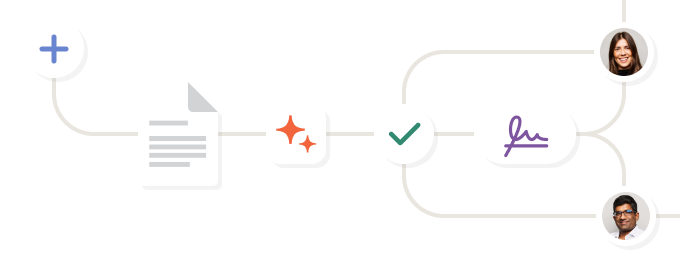
Automated workflows. A strong CLM lets you set up approval flows, assign roles, and move contracts through their lifecycle without relying on email or coding. This is a core driver of efficiency and ROI.
AI functionality. While it won’t do your job for you, AI can handle repetitive tasks like tagging fields, extracting key details (like names, dates, and values), and surfacing risk. These tools free up legal teams to focus on more strategic work.
Contract repository. A searchable, centralized contract database is essential. It should allow you to find agreement details quickly, get alerts for renewals, and pull insights across contracts to inform future strategy.
To help you make sense of the contract management landscape, we’ve gathered insights from real users across trusted review platforms like G2 and Capterra about current CLM software vendors.
While we’ve included Ironclad, our own platform, in this list, we’ve aimed to present all tools fairly, based on public feedback. This list is presented in alphabetical order, and you may notice that there are actually 16—not 15—CLMs listed. That’s because we think we’re among the best contract lifecycle management software available, but we want you to judge for yourself.
Market leaders
The market leaders in contract management software are the big, all-in-one platforms that companies rely on to handle their complete contract lifecycles, end to end. Many of these were featured as leaders in the Gartner Magic Quadrant for Contract Life Cycle Management report, highlighting their strong market presence and capabilities.
Best for large enterprises or organizations with complex, highly specific contract management needs.
Agiloft’s top three verticals are healthcare, business services, and manufacturing, with a strong focus on legal, procurement, and sales teams. Its platform is well-suited for complex use cases, including the management of unstructured contract data and automation of post-signature workflows.
Pros:
“In all of the years that we have used the product, it has consistently been the most reliable software that I manage. Agiloft allowed us to retire our in-house contract database, which did not have the search capabilities and reporting options that Agiloft has.”
Difficult and lengthy setup. Implementation process that can be complex and time-consuming
Heavy ongoing maintenance. Regular need for IT or external support for updates and adjustments
Steep learning curve. Significant training required and a high barrier to entry
Interface challenges. Less intuitive design for some users, particularly those without technical backgrounds
Conga
Best for large enterprises that use Salesforce
Conga’s top three verticals are communications and media, banking and securities, and healthcare, with the majority of organizational users in legal, procurement, and sales.
Best for companies primarily focused on contract signing
DocuSign’s most widely known for its eSignature capabilities and its top three verticals are high tech, business services, and healthcare. 50% of their customer base are in sales roles, while the other half is made up of legal, procurement, and others.
Pros:
“Easy to use and simple. I love to use it for signing any documents.”
Best for small-to-midsize companies looking for AI-powered features
Evisort’s top three verticals are healthcare, banking and securities, and communications and media. The majority of their customers are smaller companies, but it does serve some larger organizations. Evisort is known for its proprietary large language model (LLM) and AI and GenAI-native features.
Pros:
“The speed at which Evisort reviews and extracts contractual information is amazing. The accuracy of the extracted information… is extremely high.”
Best for large, complex enterprises that manage high volumes of contracts
Most of Icertis’ customers are enterprise companies, primarily in the manufacturing, healthcare, and high-tech sectors. Its organizational users are equally split between legal, procurement, and sales roles, and it’s especially known for a platform that’s intuitive for both the buying and selling side of contracts.
Pros:
“The contract authoring features and the search features to the Icertis tool suite really allow the various stakeholders to fully take advantage of the tool suite. Whether you are on the procurement team, legal team or commercial management team you will be able to search for key risk issues and deliverables.”
Strong approval and automation capabilities. Supports contract workflows with built-in automation and structured approval processes
Comprehensive contract and document management. Offers a centralized system for organizing and tracking contracts
Manageable platform navigation. Reported ease of use after thorough onboarding
Detailed workflow control. Enables granular management of contract stages and stakeholders
Cons:
“While Icertis presents all the functionalities and features of a contract lifecycle management tool, the implementation and training are items that were quite tough to get used to.”
Weak email and notification functionality. Reported issues with e-signatures, alerts, and email integration will save XXX hours and finance will be happy because we will be able to save $XXX amount of dollars on future renewals.”
Lengthy implementation. Extended onboarding and setup times, making cross-functional adoption difficult
Steep learning curve. Basic proficiency requires extensive training, potentially discouraging continued use
Expensive and consultation-heavy. Significant investment in external consultants needed for effective setup
Best contract lifecycle management for enterprise companies with diverse cross-functional needs
Ironclad is ideal for organizations that require a CLM capable of adapting to different departmental contexts, easy adoption at scale, and strong integrations with existing technology stacks. It serves midsize to enterprise companies and its primary industries are high tech, manufacturing and business services.
Pros:
“We generate 100s of NDAs per month globally, Ironclad helps us keep the process as streamlined and smooth as possible across the different business units. Making the process more user friendly and standardized to minimize human error or mistakes. This has decreased our NDA completion from 2-3 months, to a couple of days/weeks.”
Streamlines contract creation and approvals. Intuitive workflows that automate complex processes without engineering support
Store and search for contracts. Repository used as a central location to find and reference agreements quickly
Valuable data. Insights dashboard offering visibility into contract metrics, bottlenecks, and cycle times
eSignature. Native signature tool embedded within the Ironclad app
AI-powered contract analysis. AI tools that support greater efficiency in daily contract work
Cons
“With any CLM there’s always room for improvement and the feedback I get most from the users in my company is the repository and how this can be improved for better usage.”
Repository functionality and dashboard. Some users report difficulty navigating the repository to find documents.
Frequent updates. Users report that updates to the product happen often, which can change their familiarity with the platform.
New user adoption. Difficulty motivating new team members to complete onboarding resources
Robust features. Created for the entire contract lifecycle, so if your team just needs to sign contracts, there’s probably a more affordable option with basic features.
Best for lean, fast-moving legal and business teams of startups or mid-sized companies.
Juro is commonly used by procurement, legal, HR, and finance teams—particularly within B2B SaaS, food delivery, automotive marketplaces, and travel platform companies.
Pros:
“Using Juro as our CLM tool has changed the game for our legal team. Implementation was excellent—Juro’s onboarding team assisted us in setting up template contracts, defining workflows, and setting up a repository for easy reference. Each of our contract stakeholders has increased visibility into contract terms and status.”
Streamlined contract creation. Automated drafting to save time and reduce reliance on manual processes
User-friendly interface. Intuitive navigation, especially for simple contract workflows
Responsive customer support. Positive experiences reported with support team responsiveness
Time efficiency. Faster progress by simplifying routine contract tasks
Cons:
“Sometimes, it adds extra steps to the process. For example, if any minor change is made to a contract, the platform requires to send it to the counterparty, and the counterparty still has to send the contract back to us, before we can accept the changes and send for signature.”
Inconsistency. Gaps in features beyond contract creation, limiting end-to-end use
Limited contract data. Challenges in surfacing and reporting on key terms for risk and compliance
Counterparty friction. Difficulties for external collaborators interacting within Juro’s platform
Feature limitations. Missing capabilities like advanced customization, flexible e-signature options, and robust formatting tools
Malbek
Best for teams who work cross-functionally across several departments and want a no-code CLM.
Malbek’s top industries are life sciences, manufacturing, consumer packaged goods, and retail, and its top users include roles in procurement, legal, sales, and finance.
Pros:
“An intelligent platform for form management that serves a variety of departments within the organization.”
Collaboration features. Real-time negotiation and multi-stakeholder input to improve speed to contract
Responsive customer support. Highly rated implementation and support teams assisting with onboarding and troubleshooting
Cons:
“One area for improvement is the ability to control users’ security settings on an as needed basis for individual contracts or documents. Adding more granular security control would be a valuable enhancement for protecting sensitive contracts/documents.”
PandaDoc was created for sales teams to send proposals, and that remains the core of their business. Its top industries are SaaS, professional services, healthcare, education, and construction.
Pros:
“Reliable, user-friendly platform for contract management”
Limited end-to-end CLM functionality. Lacks key features for full contract lifecycle management, like negotiation and approval workflows
Manual template updates. Requires users to manually update templates before approvals, slowing down the process
Collaboration constraints. Not built for real-time collaboration across legal, procurement, or finance teams
Minimal contract data insights. Offers limited reporting and analytics, making risk assessment and compliance tracking difficult
Sirion
Best for enterprise-level organizations that need innovative AI features and robust post-signature contract management.
Sirion’s top three verticals are banking and securities, communications and media, and healthcare. It’s known for its standout AI features include conversational search, AI-driven risk reviews, and auto-redlining, as well as its post-signature management features that track compliance after contract execution.
Pros:
“As a contract manager, I like the feature that allows me to view the full scope of upcoming and outstanding deliverables for every contract. All that information is readily available, and I can drill down to the specific deliverable and check with stakeholders on its status without ever leaving the tool to communicate directly to each person.”
AI-powered contract intelligence. AI extraction of obligations, clauses, and key dates to reduce manual review
Advanced post-signature management. Tracking of performance, obligations, and compliance after contract execution
Collaboration tools. Features like clause-level negotiation and in-platform redlining to facilitate legal collaboration
Audit trails and compliance. Strong audit capabilities and version control supporting compliance and risk management
Cons:
“The implementation of the tool in existing teams and major legacy engagement has a learning curve that needs to be considered at decision to implement. It needs dedication and from time to time also benefits from scrutinizing our own standardisation to benefit fully.”
Steep learning curve. Difficulties learning the platform, especially when configuring complex workflows or features
User interface design. Perception of a dated or less intuitive UI compared to similar CLM tools
Performance lag. Occasional slowdowns or long load times, particularly with large contracts
Limited out-of-the-box integrations. Need for technical support or custom work to integrate with third-party tools
New additions on the rise
With more and more CLM solutions being added to the market, there are definitely some standout newcomers, many of which are classified as challengers in the Gartner Magic Quadrant for Contract Life Cycle Management report, highlighting their potential.
ContractWorks
Best for teams that primarily need a secure, easy-to-use place to store contracts, along with basic workflow and collaboration features.
Users say: ContractWorks excels in the areas of document management, storage, and organization, but does not have some of the more advanced features and integrations as more robust CLMs.
Cobblestone Software
Best for teams that want lots of features and are willing to invest time to learn them.
Users say: It’s powerful and customizable, but non-technical users struggle with complexity and lack of real-time collaboration.
Outlaw
Best for businesses that want to streamline contract creation with a modern interface.
Users say: The tool is sleek and user-friendly once learned, but has limited analytics and integrations.
Lexion
Best for legal teams looking to adopt AI-driven contract analysis and evolve their processes.
Users say: It’s smart and promising, but struggles with data in tables, connecting related documents, and nuanced contract types.
ContractPodAi
Best for companies seeking AI features and agents.
Users say: They appreciate enhanced productivity through AI-driven automation, but implementation can be lengthy and complex.
SpotDraft
Best for growing businesses wanting affordable automation and risk insights.
Users say: It’s great for automating basics and improving visibility, but can feel rigid or limiting in cross-functional workflows.
Recent developments in contract management
The CLM landscape is always evolving, which means that managing your contracts should continue to get easier and faster.
Legal ops becomes strategic business driver
Over the last decade, legal operations has moved from a support function to a strategic cornerstone of the legal department. CLOC’s State of the Industry Report found that 83% of departments expect demand for legal services to continue rising, with the top five legal ops functions either expanding or remaining essential to daily operations.
To meet that growing demand, 77% of respondents said increasing legal operations headcount is a medium or high priority—underscoring a broader shift toward operational excellence, scalable systems, and tools like contract management software that helps legal teams do more with less.
But the most meaningful shift isn’t just operational—it’s relational. Legal ops teams that once spent their time buried in administrative tasks are now emerging as valued strategic advisors. By implementing the right systems and driving efficiency, legal leaders are earning credibility with business partners and transforming how legal is perceived across the organization.
Contracts are no longer seen as blockers. Instead, they’re recognized as a key part of driving the business forward. With the help of CLMs and the data they unlock, legal teams can clearly demonstrate their impact. They can report on metrics like workload, turnaround time, and negotiation rates. More importantly, they can show how their work connects to business outcomes, such as revenue influence, legal involvement in key deals, and areas where contract value may be lost.
This evolution reflects a deeper truth: when legal operations runs smoothly, it builds trust. And with that trust comes influence. For more tips on becoming a strategic driver in your organization, read our Legal Operations Field Guide.
Legal teams are rethinking their tech stack
If you’re exploring contract management solutions as part of a broader effort to update your data and technology strategy across your legal department, you’re not alone.
According to a recent EY survey, 75% of legal teams are actively developing or improving their approach to legal technology and data, hoping to find solutions for persistent challenges like disorganized data (52%), disconnected systems between legal and business platforms (44%), and limited access to accurate, real-time information (41%).
AI leads the way
As more legal departments modernize their processes, it’s clear that those who don’t risk falling behind. In our State of AI in Legal Report, we found that 69% of legal professionals are already using AI in their work, and 93% of those users say it’s made their work better. On top of that, 72% say it’s improved their work speed.
That’s where modern CLMs come in. Today’s leading platforms embed AI directly into day-to-day contract work—from drafting to redlining to routing approvals—so teams can work smarter without needing to learn a completely new system. But contract management tools aren’t the only place where AI is making a major impact.
The legal tech ecosystem is rapidly expanding with the rise of LLM-powered tools like Harvey, Luminance, Spellbook, and Legora, all of which are changing the way legal teams approach contract work. These tools use large language models to handle complex tasks such as clause analysis, contract drafting, compliance checks, and even legal research. For example:
Jurist can draft, edit, review, and research contracts, leveraging AI to streamline legal workflows.
Harvey is helping firms automate legal reasoning and generate draft responses in complex litigation.
Spellbook integrates directly with Microsoft Word to suggest clause edits, flag risks, and even propose full contract language using OpenAI’s models.
Luminance focuses on contract analysis, surfacing anomalies and risk patterns across large contract sets.
Legora is emerging as a player in AI-assisted negotiation and redlining.
Many legal departments are using these tools in tandem with traditional CLMs—either as complementary layers of automation or as point solutions for specific contract workflows. The result? Faster review cycles, less manual work, and smarter decisions driven by contract data.
AI is no longer just a “bonus feature” in contract management. It’s becoming a fundamental part of how legal teams operate. And the pace of innovation is accelerating: Gartner predicts that by 2027, AI will handle 50% of procurement contract management tasks, including drafting, risk analysis, and editing.
Legal teams that embrace these changes now will be better positioned to scale, reduce risk, and contribute strategically to the business, while those that wait may find themselves playing catch-up.
How to get buy-in for contract management tools
You may be excited about the opportunities that a CLM represents, but you might still need to get stakeholders on the same page. Here are tips for championing change at your organization.
Building the business case for contract management software
Contracting has long been seen as a necessary but manual and siloed function. But with the right contract lifecycle management solution, it becomes a strategic advantage. A modern CLM helps teams accelerate revenue, reduce risk, control costs, and uncover insights that inform better decisions. It is not just about doing legal work faster—It’s about helping the entire business operate more effectively and competitively.
It’s a given that CLMs drive efficiency, but the real value lies in the strategic outcomes they enable. Let’s take a closer look at what those are.
Mitigate risk
Mitigating legal and compliance risk is one of the strongest arguments for investing in contract management tools. With AI-driven visibility, standardized workflows, and full-lifecycle governance, your business can stay ahead of potential issues, ensure compliance, and protect your bottom line.
But a CLM can help mitigate risk in ways that go far beyond core features, as Plaid demonstrates by using it to manage third-party risk. “After discussing the CLM use case with various stakeholders and getting a better understanding of the product workflow capabilities within Ironclad, it occurred to us: we’ll be able to customize Ironclad to perform various vendor risk assessments all within the platform.,” said Kenneth Thomas Moras, their Security, Governance, Risk, and Compliance Lead.
Accelerate value
By streamlining the contract lifecycle and enabling faster, smarter negotiations, your business can close deals more quickly and maximize financial outcomes.
At Ironclad, our very own sales team uses our Salesforce integration to manage contracts and close deals 70% faster. “I am a firm believer that the most successful way to acquire customers is to dedicate time to building trusting relationships and collaborating on creative solutions that match their unique needs. By streamlining the amount of effort it takes to create a compliant contract and collect the right approvals, the new sales contracting process has truly freed up my team’s time and enabled them to redirect their focus to where it matters: the customers,” said Brooke Adair, Director of Sales at Ironclad.
Reduce spend
Better visibility into contract data means your team can identify revenue leakage, consolidate vendors, and take proactive steps on renewals to avoid unnecessary costs.
With increased collaboration between procurement and legal using a CLM, The State of Oklahoma’s OMES has saved $66K since November 2023. Their procurement team said, “The improvements in business processes and automation that will be effectuated through analysis of the metrics and performance indicators are still in their infancy, but the total savings and increases in efficiency are slated to increase year over year for the foreseeable future.”
Keep up with the speed of business
Keeping up with the speed of business is essential for growth, but contracts are often a major bottleneck that slows teams down and stalls progress. The right CLM should empower your legal and procurement teams to manage a growing volume of contracts efficiently, move faster, and focus their time on high-value, strategic work.
Within three months of CLM implementation, DentalCorp reduced their contract drafting time from 15 minutes to 4 minutes per contract. But the impact didn’t end with the legal team’s efficiency. “We have received glowing feedback from users outside of legal,” said Aneta Ciesla, Senior Manager of Legal Operations. “Our operations team is much more organized because they know exactly where each contract stands. They can simply log in and see who is approving and what the current status is.”
On the flip side, having contract management software with AI-driven features enables Signifyd’s contract manager to self-serve more of the contracts process without involving legal at every step. That way, their legal team can focus on the highest-impact work without getting bogged down by administrative tasks and reviews.
“[A CLM with AI features] enables me to do my job more independently. I know our product really well, but I’m not an attorney. This is helping me achieve my tasks a lot faster, requesting legal input only when needed, which frees up legal’s time for more complicated matters,” said Zuhair Saadat, former Contracts Manager at Signifyd.
Prepare for questions and objections
Anticipating any hesitations ahead of time will help you build your case. Here are some of the most common objections that product champions may face:
“It will take up too much IT time.”
Many CLMs are designed to support team self-service and offer integration APIs that empower users while reducing the workload on IT teams. This means business users and entire departments, like legal, procurement, sales, or finance, can manage contracts independently without constantly relying on IT for support.
In other cases with more robust CLMs, there are also low-code options that don’t require much effort from the IT team. Choosing one of those options should satisfy your tech department, especially if you include them when scheduling a demo. Plus, the right best management tools can actually reduce IT involvement in the long run by eliminating manual fixes, patchwork solutions, and one-off tech requests.
“Setting it up end-to-end is too much work.”
You don’t need to start at the end; many companies begin with easy wins (like getting existing contracts into a smart repository) and expand the project to high-value use cases when the business is ready to take on that more strategic project.
Alternatively, you can begin with a pilot project in one department or contract type to demonstrate the CLM’s value, identify challenges, gather feedback, and then iterate to gain broader buy-in and expand usage.
“Contract management tools are too expensive.”
It’s a common concern, but it also misses the big picture. The real question isn’t how much a CLM costs, but how much long-term value it can deliver and the costly risks it could help you avoid.
When evaluating a new CLM for your organization, it’s common to focus on the upfront cost, but it’s even more important to consider the long-term benefits and value the software provides. A quality CLM can deliver measurable ROI within six to twelve months by reducing legal bottlenecks, automating manual work, and giving you better control over contract risk.
The real cost often lies in doing nothing—or investing in the wrong tool. Without a strong CLM, organizations face delayed deals, missed renewal deadlines, fragmented communication, and endless email chains. These hidden inefficiencies quickly compound into lost revenue, increased risk, and frustrated teams.
Consider these examples of scenarios with and without the right CLM for your business:
Customization
With the right CLM: Configure the platform to meet your specific needs
Without the right CLM: Pay for software you only partially use—or that requires workarounds to meet your specific needs
Integrations
With the right CLM: Integrate your CLM and contract management processes with your existing tech stack
Without the right CLM: Waste valuable time transferring contracts and information
Contract analysis
With the right CLM: Access and analyze your contract data, identifying bottlenecks and improving processes
Without the right CLM: Waste time and money on inefficient processes without clear insight into how to improve them
Data migration
With the right CLM: Use a platform that does it all for you and saves you both time and money on managed services
Without the right CLM: Face unexpected costs when transferring your existing contracts into the new platform
Updates and maintenance
With the right CLM: Receive updates and new features seamlessly
Without the right CLM: Rely on outdated processes that are slower, less efficient, and lacking modern capabilities
Tech support
With the right CLM: Get technical support quickly and easily
Without the right CLM: Spend valuable time—yours or your IT team’s—troubleshooting and managing manual workflows
Training and enablement
With the right CLM: Train users effectively and scale processes across your organization
Without the right CLM: Have limited time or resources to enable others—often leaving just one person in the company who knows how to manage the process
Professional services
With the right CLM: Reduce or eliminate the need for professional services through self-serve features and support, helping you save on additional costs
Without the right CLM: Incur costs for things like data governance, change requests, changing contract standards, new workflow creation, and much more.
By helping your team understand the total cost of ownership for CLMs, you can set expectations early and highlight the long-term value of investing in the right solution.
A legal transformation
Choosing the best contract management tool is a big decision, but the right CLM quickly proves its value. With embedded AI, intuitive workflows, and seamless integrations, today’s leading platforms become more than just tools; they become essential to how your business operates.
A well-chosen CLM doesn’t just streamline contract processes—it transforms legal into a proactive, strategic partner across the organization.
Ready to see if Ironclad is the right solution for your business? Talk to an expert.
Quiz: test your own contract management process!
Ironclad is not a law firm, and this post does not constitute or contain legal advice. To evaluate the accuracy, sufficiency, or reliability of the ideas and guidance reflected here, or the applicability of these materials to your business, you should consult with a licensed attorney. Use of and access to any of the resources contained within Ironclad’s site do not create an attorney-client relationship between the user and Ironclad.