















Legal burnout is a documented and worsening problem in the profession. Bloomberg Law’s 2024 Attorney Workload Survey found that attorneys reported feeling burned out 42% of the time, with mid- and senior-level associates experiencing burnout at a rate of 51%. This represents a concerning trend where lawyers consistently report feeling burned out nearly half the time they’re working.
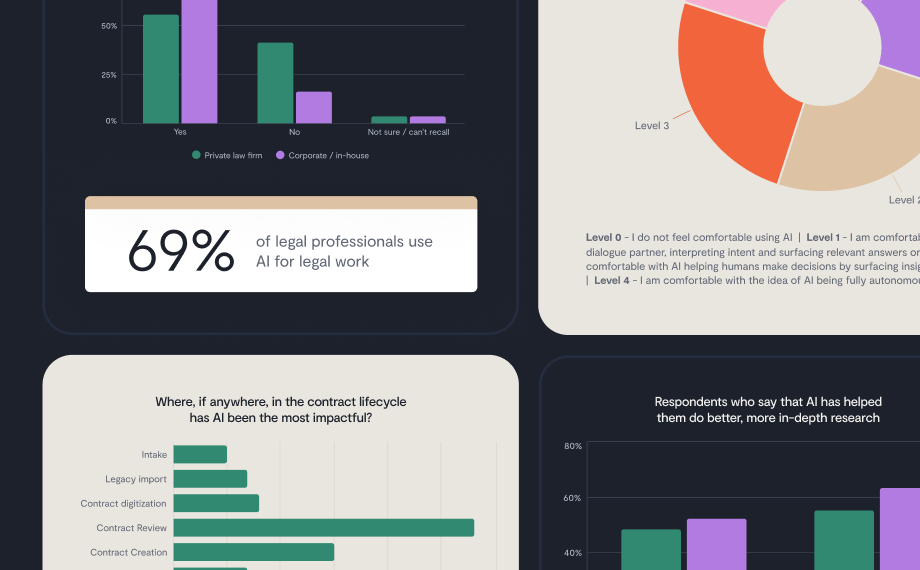
But there’s promising news emerging from recent research. Ironclad’s 2025 State of AI in Legal Report, which surveyed 800 legal professionals evenly split between law firms and in-house settings, found that 76% of lawyers using AI report it’s helped reduce their feelings of burnout. The same study revealed that 96% agree AI has helped them achieve business objectives more easily, and 57% report being able to be more strategic with their work when using AI.
Solving for burnout, then, comes down to working differently, not necessarily working less. AI is helping lawyers escape the trap of spending their days on mind-numbing tasks that drain energy without providing any sense of accomplishment.
What’s really causing legal burnout
Burnout is defined in research as “a psychological syndrome emerging as a prolonged response to chronic interpersonal stressors on the job” with three key dimensions: overwhelming exhaustion, feelings of cynicism and detachment from the job, and a sense of ineffectiveness and lack of accomplishment (Maslach & Leiter, 2016).
The legal profession has created conditions that foster this syndrome through billable hour requirements that prioritize quantity over quality, a culture that equates long hours with dedication, and business models that reward time spent rather than outcomes achieved. The profession’s risk aversion leads to over-documentation and excessive review processes, while competitive pressures create environments where admitting you need help is seen as weakness.
The data tells the story: Bloomberg Law found that when attorneys scored their well-being on a 10-point scale, the average was just 6.5. Younger lawyers are hit hardest, with those aged 25-34 reporting burnout 58% of the time compared to just 23% for lawyers over 65.
The science of meaningful work
The psychological research is clear: meaningful work acts as a buffer against job burnout. When people find purpose and impact in their daily tasks, they experience significantly lower rates of exhaustion and cynicism.
Think about it this way: when you spend your day on repetitive administrative tasks, your brain registers this as wasted effort. But when AI handles routine work and frees you up for strategy and problem-solving, you’re engaging the parts of your brain that create satisfaction and progress. When 57% of lawyers using AI report being able to be more strategic with their work, they’re describing this fundamental psychological shift from feeling like expensive administrative assistants to actually practicing law again.
5 practical ways to use AI to prevent burnout
Automate your most tedious tasks
Start by making a list of everything you do that feels mechanical and systematically hand those tasks off to AI:
- Contract review and analysis – Use AI to flag standard clauses, identify deviations from templates, and summarize key terms. According to Ironclad’s survey, 28% of legal professionals cite this as their most impactful AI use case.
- Document summarization – Let AI create executive summaries of lengthy case law, discovery documents, and legal briefs. The Ironclad survey found that 61% of lawyers already trust AI for case law summarization.
- Legal research – Use AI to compile initial research on legal topics, statutes, and precedents. According to the same survey, 60% report AI helps them do better research in less time.
- Document drafting – Generate first drafts of standard motions, letters, and routine legal documents.
Streamline your communications
According to Ironclad’s research, legal professionals spend 6.2 hours every week communicating with stakeholders, and 80% call it “very time-consuming.”
- Rewrite for different audiences – Use AI to translate complex legal language into plain English.
- Draft routine correspondence – Let AI handle first drafts of status updates and routine communications.
- Create templates – Use AI to build email templates for common situations.
- Improve clarity – Run your writing through AI to make it more concise.
Prioritize strategic work that actually energizes you
If you’ve managed to offload tedious tasks, you can look towards tasks that provide the psychological rewards that tedium cannot:
- Complex legal analysis that requires your expertise and judgment
- Deeper client relationships through more meaningful interactions
- Business strategy for your practice or department
- Professional development that advances your career
Create actual breathing room in your schedule
AI can help you get ahead of the curve:
- Batch process documents using AI review, then spend focused time on the exceptions
- Automate status reporting so you’re not constantly updating stakeholders manually
- Use AI for preliminary research so you can dive straight into analysis
- Generate meeting prep materials automatically from case files or contracts
Build better work boundaries
AI helps by making your work hours more productive, which makes it easier to disconnect:
- Identify areas to up automate workflows that continue working even when you’re not
- Use AI scheduling to optimize your calendar and protect focus time
- Create helpful out-of-office responses that actually help people get what they need
- Implement AI triage for incoming requests to handle urgent vs. non-urgent items automatically
Getting started this week
Pick one area and test it for the next seven days:
- Choose one repetitive task that frustrates you most
- Find an AI tool that can handle it (start with ChatGPT, Claude, or your firm’s approved tools)
- Test it on a small sample and measure both time saved and how you feel afterward
- Document what works and adjust what doesn’t
- Scale up gradually once you’ve proven the concept
The bottom line
Burnout happens when your daily work doesn’t align with your broader aspirational goals. AI offers a path back to meaningful legal work by handling the administrative tasks that drain energy without providing satisfaction.
You didn’t get into the legal field to spend your career reformatting documents and writing status emails. AI can help you get back to actually doing true legal work—and rediscovering why you loved it in the first place.
References:
Bloomberg Law. (2024). Attorney Workload and Hours Survey. Bloomberg Law.
Bloomberg Law. (2024). 2024 Well-Being Report: The Divide Between Health & the Legal Industry. Bloomberg Law.
Ironclad. (2025). State of AI in Legal 2025 Report.
Maslach, C., & Leiter, M. P. (2016). Understanding the burnout experience: recent research and its implications for psychiatry. World Psychiatry, 15(2), 103-111.
Ironclad is not a law firm, and this post does not constitute or contain legal advice. To evaluate the accuracy, sufficiency, or reliability of the ideas and guidance reflected here, or the applicability of these materials to your business, you should consult with a licensed attorney. Use of and access to any of the resources contained within Ironclad’s site do not create an attorney-client relationship between the user and Ironclad.